Infrastructure Contextualization
Chapter 2 set out the theoretical framework of this work and analytically derived the evaluation framework with its twelve criteria from the concept of fundamental digital infrastructure. A deductively constructed evaluation framework must, however, prove itself against the reality of established infrastructure, demonstrating that its requirements do not miss the mark. The present chapter provides this proof. It confronts the twelve criteria with seven structurally heterogeneous reference infrastructures and examines whether the analytically obtained requirements find purchase there, whether they can distinguish between the systems, and where a criterion finds no counterpart in the reference systems. The examination is therefore validation, not origin. It tests the criteria rather than generating them.
The selection of the seven reference infrastructures and their assignment to five infrastructure types was typologically justified in Chapter 2. Individual justifications follow. The selection followed two guiding principles: each infrastructure type should be represented by at least one system, and the chosen systems should be sufficiently documented to permit a source-based analysis. Within physical infrastructure, the power grid was chosen because, as a regulated natural monopoly, it is the paradigm case of public infrastructure, and the road network because, through common use right, it exhibits a legally unique form of open access. The Internet stands without alternative as digital-open infrastructure on account of its protocol-based architecture and its generative capacity. SWIFT and GPS were chosen as digital-closed systems because, despite their global reach, they exhibit fundamental restrictions in control and access, and thus function as counterexamples to open architecture. Cloud infrastructure represents the hybrid type because it possesses de facto infrastructural significance without public-law status. The legal system, finally, was included as the only non-technical infrastructure because any account of coordination and enforcement would be incomplete without an institutional reference.
Each of the seven infrastructures is examined through three guiding questions: what is the core function of the system and why is it socially relevant, what properties enable that function, and what happens when the system fails or is manipulated? The answers make it possible to test each of the twelve criteria against the concrete manifestation of the system. This chapter conducts the examination in three steps. It characterizes the seven infrastructures concisely along the guiding questions. It tests the twelve criteria against the systems and shows in what form, and with what variance, each requirement appears. From this confrontation it draws conclusions about the load-bearing capacity of the evaluation framework.
3.1 The Seven Reference Infrastructures
3.1.1 Power Grid
The power grid is the physical infrastructure for the transmission and distribution of electrical energy from generation facilities to end consumers. In Germany, the transmission grid is operated by four operators under the supervision of the Bundesnetzagentur, and the transport layer exhibits the properties of a natural monopoly: high sunk costs and economies of scale make the parallel construction of a second grid physically and economically pointless.1 The core function of the power grid, the permanent provision of electrical energy for all downstream sectors, is not substitutable by any alternative system. No other infrastructure sector functions without electricity: telecommunications, water supply, transport systems, healthcare, and financial markets are all electrically dependent, making the power grid a meta-infrastructure whose failure produces cascading effects beyond its own sector.2
The infrastructural properties of the power grid are shaped by two principles. The layer separation through unbundling, which Europe has progressively implemented since 1996, structurally separates generation, transport, and retail from one another and ensures that every generator can feed in without having to own or operate the grid.3 The grid is thereby source-neutral: whether electricity comes from a nuclear power plant, a wind turbine, or a solar installation is irrelevant to the transport layer. Regulation by the Bundesnetzagentur, which monitors grid tariffs, investments, and system stability, is constitutive of the functioning of the grid, because the monopoly character of the transport layer would, without external control, tilt into discrimination or exploitation.4 In normal operation the system is extraordinarily stable: the average outage time in Germany is 10 to 15 minutes per year, one of the best values worldwide.5
The infrastructure-specific observation of the power grid concerns the physically enforced real-time coordination without margin for error. Electrical energy cannot be stored in the grid. Generation and consumption must be in exact equilibrium at every moment, measured by the grid frequency of 50 Hz in Europe. Deviations above a certain threshold produce cascade failures, because the system admits no gradual loss of quality. In the blackout in the northeastern United States and Canada in 2003, a single unpruned tree led to a cascade failure that affected 55 million people and caused estimated economic damage of 4 to 10 billion US dollars.6 None of the other seven systems examined exhibits this zero tolerance for desynchronization. The Internet transports packets asynchronously and tolerates latency fluctuations. The road network organizes itself in a decentralized manner and absorbs local disruptions through alternative routes. The power grid, by contrast, operates permanently at the limit of its physical tolerance, and society becomes aware of this property only when the limit is exceeded. This observation illustrates Star’s insight about visibility upon breakdown.7
3.1.2 Internet (TCP/IP)
The Internet is a global network of approximately 70,000 autonomous systems communicating via the shared protocol TCP/IP.8 It comprises the physical transport layer of fiber optics, copper, and radio technology, the logical layer of protocols (TCP/IP, BGP, DNS), and the application layer (HTTP, SMTP, and their successors). The core function consists in vendor-independent, technology-neutral networking: TCP/IP abstracts the physical transport layer, so that for the application level it is irrelevant whether data are transmitted via fiber optics, copper, or radio. Before TCP/IP, network communication was dominated by proprietary, mutually incompatible systems. The open protocol replaced these monopolies with a freely available standard that anyone can implement.
The outstanding infrastructural properties of the Internet lie in the combination of open protocol architecture and decentralized governance. The Internet has no owner and no central regulator. Instead, the IETF develops technical standards on the basis of “rough consensus and running code,” while ICANN administers the Domain Name System and IP address allocation.9 98 percent of international data traffic flows through more than 500 submarine fiber-optic cable systems with a total length of 1.5 million kilometers, with resilience geographically unevenly distributed: Europe and North America have massive redundancy, while island states can be cut off by a single cable break.1011 In failure behavior the Internet shows a fundamentally different pattern from the power grid: it typically loses performance gradually, gains latency, and loses bandwidth, while BGP automatically calculates alternative routes.12
What distinguishes the Internet from the other infrastructures is the end-to-end principle as an architectural decision that has enabled permissionless innovation. Saltzer, Reed, and Clark formulated it in 1984: intelligence sits at the endpoints, the network itself is “dumb” in the sense that it transports packets without knowing or deciding what they contain.13 Anyone who wanted to build a new application needed no permission from a network operator. Van Schewick showed in 2010 that this architectural property had direct economic consequences. The end-to-end principle reduced innovation barriers to nearly zero and enabled the emergence of the World Wide Web, e-commerce, cloud computing, and social media, without any central authority having to authorize or even anticipate such developments.14 None of the other infrastructures examined exhibits this architecturally anchored permissionlessness in comparable form: the power grid qualifies feeders technically, SWIFT ties access to compliance, and even the road network, beyond common use, has access restrictions in the form of special use permits.
3.1.3 Road Network
The road network in Germany encompasses more than 830,000 kilometers of traffic routes, from motorways through federal and state roads to municipal roads, and is the most extensive man-made infrastructure in physical terms.15 Its core function lies in comprehensive territorial coverage: it reaches every location, every building, every settlement. Neither rail nor waterway nor air routes provide this universal connectivity. The last mile of every transport chain is almost always a road. The economic significance of this coverage is empirically documented: Aschauer estimated a positive output elasticity for public capital, and particularly for transport routes, thereby making visible the contribution of infrastructure to overall economic productivity.16
The infrastructural properties of the road network are shaped by the combination of public provision and decentralized operation. The provision and maintenance of transport infrastructure is, in German law, a public service obligation and thus a direct task of the public authorities, distributed vertically among the federal government, the states, and municipalities.17 Unlike the power grid with its control centers or the Internet with its BGP routing, the road network has no central operational control: every road user navigates independently, and coordination is handled by decentralized rules and physical infrastructure such as traffic lights and signs. In failure behavior the road network resembles the Internet: local outages are typically absorbed by alternative routes without the overall system collapsing, as the 2007 collapse of the I-35W bridge in Minneapolis clearly demonstrated, leading to local traffic diversions rather than a systemic collapse of the road network.18 The real threat to the road network lies in the creeping decay caused by underinvestment. It unfolds over decades, and the OECD puts the global infrastructure financing gap at approximately one trillion US dollars annually.19
The unique property of the road network lies in common use right as the legal form of open access. German road law recognizes common use as the designated, typically free-of-charge, and equal use by all within the framework of traffic regulations.20 Access to the road is a subjective public right arising from the statutory dedication and revocable only by changing that dedication. This construction differs fundamentally from all other forms of access in the sample: the power grid offers regulated access tied to technical prerequisites and contractual relationships. The Internet requires a connection contract with a provider. SWIFT restricts access to authorized financial institutions. Common use right is one of the oldest forms of institutionally secured inclusivity, and it defines access to infrastructure neither technically nor economically but juridically as a fundamental right. Frischmann’s argument that open access to infrastructure can be economically efficient finds its long-established legal counterpart in common use right.21
3.1.4 SWIFT
SWIFT (Society for Worldwide Interbank Financial Telecommunication) is a messaging network for standardized communication between financial institutions. It transmits payment instructions, securities transactions, and treasury operations, but does not itself move money. The actual value transfer is handled by correspondent banks and payment systems such as T2 in Europe or Fedwire in the United States. Around 11,000 financial institutions in 212 countries and territories are connected, at an estimated daily transaction volume of approximately 5 trillion US dollars.22 The core function of SWIFT lies in the standardization and transmission of financial messages, and its quasi-monopoly position rests on the network effect of universal adoption: China’s CIPS processed only 6.6 million transactions in 2023 compared to SWIFT’s approximately 11 billion annually, even though it was conceived as a political alternative.23
SWIFT is organized as a Belgian cooperative owned by its member banks, supervised by G10 central banks with the Belgian National Bank as lead overseer. Access is permissioned by design: only authorized financial institutions can participate, private individuals have no direct access, and AML, KYC, and CTF compliance are mandatory prerequisites. The actual settlement runs through bilateral correspondent relationships, a federated architecture of independent payment systems in various jurisdictions. The chain of trust is long and opaque for the end user: whether a transfer has been correctly processed is not something the end user can verify independently, and cross-border payments take 1 to 3 days with stacked fees and opaque intermediate states.
SWIFT exhibits a property that appears in none of the other systems in the sample in this form: the combination of network effect as the monopoly base and vulnerability to geopolitical instrumentalization. The system’s lack of alternatives rests on network-effect lock-in, even though the SWIFT protocol would be technically replicable. Virtually every financial software system worldwide processes SWIFT formats, and the message standards established by SWIFT (MT messages, ISO 20022) have developed a life of their own that extends beyond the network. The geopolitical dimension shows in the sanction disconnections: in 2012, Iranian banks were cut off from the network by EU decision. In 2022, Russian banks were cut following the invasion of Ukraine.24 This instrumentalization reveals a tension that is central to the infrastructure question: SWIFT claims neutrality as messaging infrastructure, but selectively abandons that neutrality under geopolitical pressure. Control by G10 and EU central banks means de facto western control over global financial messaging. The direct consequence is the fragmentation risk: the existence of CIPS (China) and SPFS (Russia) as alternative systems shows that an infrastructure whose neutrality is perceived as selective triggers sovereignty responses and loses its universal validity.
3.1.5 GPS
The Global Positioning System consists of 31 satellites in six orbital planes orbiting Earth at an altitude of 20,200 kilometers and permanently transmitting position and timing signals.25 GPS provides three functions (positioning, navigation, and timing) and was launched in 1978 by the US Department of Defense as a military system. Civil use began in 1983 as a response to the shootdown of Korean Air Lines Flight 007 and was extended to full civil accuracy in 2000 by deactivating intentional signal degradation (Selective Availability) under President Clinton.2627 The entire civil GPS infrastructure, on which financial transactions, mobile networks, power grids, and precision agriculture now depend as a time reference, is an unintended byproduct of a military investment.
A fundamental design difference shapes the infrastructural properties of GPS: satellites transmit signals but receive none from users. There is no interaction, no registration, no authentication. The system scales perfectly, because capacity is independent of the number of users, whether one or eight billion receivers. At the same time, this architecture means that civil GPS signals are unauthenticated: the receiver cannot cryptographically prove that the received signal is genuine, and spoofing is possible and documented. Only the military M-code offers cryptographic authentication, which creates a two-class system on the same physical infrastructure: civil receivers with 5 to 10 meters accuracy and no spoofing protection, military receivers with approximately 1 meter accuracy and encryption.28
GPS exhibits a property that produces the maximum asymmetry in the sample: the read-only architecture under unilateral control. Anyone can receive. No one can transmit. One party controls. GPS is operated entirely by the US Department of Defense and run by the US Space Force. Free access is a political decision that could be revised at any time, and the US government explicitly reserves the right to locally jam GPS in crisis zones. The geopolitical consequence of this asymmetry is duplication: the European Union developed Galileo as an explicit sovereignty measure, Russia operates GLONASS, China BeiDou.29 The RAND Corporation identifies GPS, owing to its cross-sector dependency, as an “attractive target for adversaries.”30 GPS thereby exhibits a property directly relevant to the research question: an infrastructure used by the entire world but subject to the sovereign control of a single state provokes duplication that fragments the universal character of the infrastructure.
3.1.6 Cloud Infrastructure
Cloud infrastructure provides compute, storage, and networking as a service. Three providers control 63 percent of the global market, which exceeds 400 billion US dollars annually: AWS with 30 percent, Azure with 20 percent, and Google Cloud with 13 percent.31 Financial platforms, healthcare systems, government services, AI applications, and communications services run on this infrastructure. Cloud requires massive capital investments in global data centers, submarine cables, and proprietary hardware, creating barriers to market entry that are barely surmountable for new competitors. Customers who deeply integrate their applications into provider-specific services are bound by vendor lock-in that arises from ecosystem depth, because the technical integration extends far beyond formal contractual commitment.
The infrastructural properties of the cloud are shaped by a tension that is unique in the sample. The economies of scale of the large providers enable lower prices, broader services, and faster innovation, but simultaneously create single points of failure. In the US-East-1 incident in December 2021, a network error caused cascading outages at DynamoDB, S3, and other AWS services, demonstrating that a single failure at one provider in one region can have global consequences.32 Cloud providers are private-sector companies without infrastructure regulation. There is no Bundesnetzagentur for cloud, no statutory dedication, no common use right. AWS, Azure, and GCP can reject customers, terminate services, and change prices. Independent verification of infrastructure integrity is not possible for the user: whether the underlying infrastructure is functioning correctly is communicated through SLAs and provider-owned status dashboards, not through independent verification mechanisms.
The infrastructure-specific observation of the cloud is the discrepancy between de facto infrastructural significance and the absence of public-law status. AWS, Azure, and GCP are de facto infrastructure on which a substantial portion of the digital economy runs, but they have no infrastructure status, no public interest obligation, and their terms of service can change at any time. This discrepancy has triggered regulatory responses: with the Data Act and the Digital Markets Act, the EU increasingly acknowledges the systemic significance of cloud providers and regulates data sovereignty through portability requirements.33 The market concentration mentioned lies in the hands of three US companies. Europe is attempting to create a sovereign alternative with initiatives such as Gaia-X.34 The parallel to the GPS situation (US control provokes a European sovereignty response) is direct. A historical parallel presents itself: the situation of cloud resembles the state of the power grid before unbundling, when the transport layer was still in the hands of vertically integrated companies and the regulatory separation of grid and use had not yet been accomplished.
3.1.7 Legal System
The legal system encompasses the totality of laws, courts, registers, and enforcement mechanisms that enable binding agreements between parties. It is the only infrastructure in the sample that is institutional rather than technical in nature. Its core function solves the fundamental problem of human cooperation: how can strangers enter into binding agreements? Avner Greif has shown that before the development of institutional law, transactions functioned only within clan, family, or ethnic networks, because reputation-based enforcement does not scale beyond small groups.35 Only state-enforced contract law makes cooperation between millions of strangers possible. The effectiveness of this infrastructure shows in how rarely courts are actually called upon: contracts function “in the shadow of the law,” as Mnookin and Kornhauser put it, because the mere existence of the enforcement possibility suffices to stabilize cooperative behavior.36
The legal system manages the state of the real world through registers: who owns which parcel of land, which company exists with which liability, which agreement applies. The register function is the institutional equivalent of what technical systems manage as State, as Hodgson has worked out in his institutional-economics analysis of capitalism.37 Verification is institutional: court proceedings are in principle public, judgments are published and contestable through appeal and revision. Access to the legal system is formally universal, but in practice unequally distributed. The so-called justice gap (the discrepancy between the formal right of access and actual accessibility) is documented in all countries.38 Globally, approximately 200 legal systems exist with different traditions that are not interoperable. There is no universal protocol that automatically mediates between jurisdictions, and cross-border contracts must clarify which law applies.
The legal system differs from all other infrastructures through institutional enforcement by means of the state’s monopoly on the use of force. No other infrastructure in the sample possesses physical enforcement power: the power grid can cut off electricity, the Internet can block packets, SWIFT can exclude participants, but none of these systems can actively intervene in reality. The legal system can, and this property makes it the meta-infrastructure within which all others operate: the power grid needs concession contracts, the Internet needs property rights to cables, SWIFT needs banking regulation, cloud providers need the enforceability of their terms of service. The question of what enforcement means in a system without a monopoly on the use of force is one of the open questions that Ethereum’s infrastructure claim raises, and one that the evaluation framework takes up through the Coordination Function (I.3). The legal system does not “fail” like a power grid. It erodes through corruption, political interference, underfunding, and loss of trust, as numerous historical and contemporary examples attest.39 Economic development correlates directly with the quality of rule-of-law institutions, which empirically underscores the infrastructural significance of the system.
3.2 The Twelve Criteria in the Mirror of the Reference Infrastructures
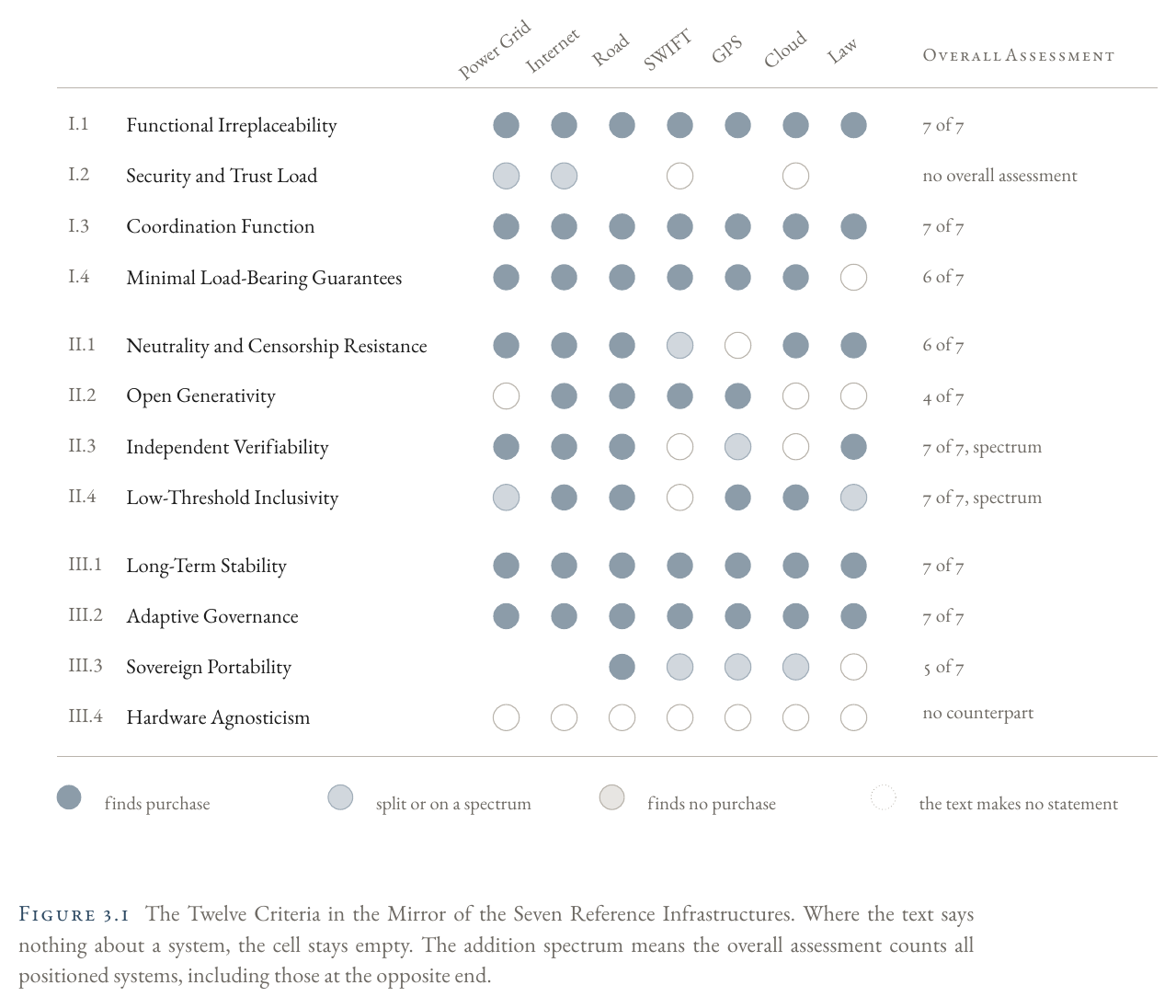
The twelve criteria are organized into three dimensions that simultaneously structure the examination. Structural Foundation (I) asks whether a system brings the load-bearing prerequisites of an infrastructure. Qualitative Load-Bearing Capacity (II) asks whether it delivers them in a neutral, open, verifiable, and accessible manner. Resilience and Sovereignty (III) asks whether it holds up under pressure and over time. Within each dimension a digit locates the individual criterion, such that Neutrality and Censorship Resistance, as the first criterion of dimension II, carries the identifier II.1. The following examination tests each criterion against the seven systems and poses a dual question: whether the required property finds purchase in established infrastructure, and with what variance it appears. Precisely this range demonstrates that a criterion draws a real distinction and does not elevate any single system form to the norm.
I.1 Functional Irreplaceability
Functional Irreplaceability (I.1) finds purchase in all seven systems, with remarkably different justification. Each infrastructure provides a function that no alternative system can comparably perform, yet the basis of irreplaceability varies. It is physical in the natural monopoly of the electricity transport layer, economic in SWIFT’s network effect, institutional in the comprehensive presence of the road network, and sovereign in the legal system’s monopoly on the use of force. The Internet owes its irreplaceability to universal protocol adoption: TCP/IP is so established as a standard that an alternative protocol would be technically conceivable but practically impossible to introduce. GPS remains without a functional equivalent as a timing reference, because Galileo, BeiDou, and GLONASS do replicate the function, but only partially replace GPS owing to its installed base (cf. 3.1.5). Cloud infrastructure, finally, is irreplaceable at the level of the economies of scale that simultaneously produce quality and concentration of power. This range confirms a structural anchoring that takes many forms.
I.2 Security and Trust Load / II.3 Independent Verifiability
Security and Trust Load (I.2) and Independent Verifiability (II.3) are tested by the same question: on what the users’ trust in the correct functioning of the system rests. The reference systems show why the evaluation framework carries two criteria here, where a superficial consideration would expect one. One requirement asks about the demand side (the trust load of the user), the other about the supply side (the verification possibilities of the infrastructure), and the two can diverge. The Internet shows the split most clearly: with TLS it offers cryptographic verification (the supply side would be satisfied), yet the chain of trust depends on centralized certificate authorities that the end user must trust. For SWIFT and cloud, the verification possibility is absent entirely, so that both requirements together yield a negative result. The power grid delivers the third constellation, in which verification is possible locally at the calibrated meter but remains reserved to the operator at the system level. That the supply and demand sides diverge for the Internet and coincide for SWIFT is the actual finding of this test: it demonstrates that the separation of the two criteria is not a conceptual duplication but a distinction that real systems enforce.
I.3 Coordination Function
Coordination Function (I.3) finds purchase in all seven systems, because every infrastructure provides a coordination service that without it would be impossible, or only possible at considerably greater effort. Here too the spectrum is wide. It spans from the physically enforced real-time coordination of the power grid, where generation and consumption must remain in equilibrium second by second, through the decentralized self-organization of the road network, to the institutional enforcement of the legal system, which makes binding agreements between strangers possible. The Internet coordinates packet routing between 70,000 autonomous systems via BGP. SWIFT mediates financial messages between 11,000 institutions in 212 countries and territories via standardized formats. GPS delivers timing signals as a time reference for financial transactions, mobile communications, and power grids. Cloud infrastructure controls the allocation of compute, storage, and network resources across global data centers. The type of coordination depends on the infrastructure type. The requirement itself is universal: without coordination performance, there is no infrastructure claim.
I.4 Minimal Load-Bearing Guarantees
Minimal Load-Bearing Guarantees (I.4), which an infrastructure must maintain even under stress, are tested by the failure behavior of the seven systems. The requirement finds purchase in six of them. The legal system constitutes the exception that sharpens the focus of the criterion. The examination reveals three distinct failure patterns. The first is cascade failure, in which a local error propagates through the system, as in the 2003 blackout in the power grid (cf. 3.1.1). The second is gradual degradation, in which the system loses performance but remains functional. The Internet loses bandwidth and gains latency with cable breaks while BGP automatically reroutes. The road network absorbs local outages through alternative routes, but with traffic jams and overloading knows a threshold beyond which the degradation endangers the infrastructure claim, because the coordination service collapses. The third is redundant stability with local vulnerability, in the case of GPS: 31 satellites compensate for individual failures, but the extreme signal weakness from 20,200 kilometers’ altitude makes the system vulnerable to ground-based jammers. The legal system explains why the requirement applies in only six systems: it does not fail technically but erodes over decades through corruption, underfunding, and loss of trust, a pattern without analogue in the technical infrastructures. This exception confirms that an infrastructure that, under stress, transitions to total failure rather than controlled degradation does not fulfill the claim.
II.1 Neutrality and Censorship Resistance
Neutrality and Censorship Resistance (II.1) finds purchase in six of the seven systems, with GPS as an instructive counterexample. The examination yields two findings, the second of which is the essential one. The first concerns the source of neutrality, which is not tied to any particular mode of origin: for the Internet it follows architecturally from the end-to-end principle, which must however be enforced regulatorily against the interests of network operators, while for the road network it is legally anchored in common use right. The second and more important finding is that neutrality can diverge at two levels, and SWIFT demonstrates this most clearly (cf. 3.1.4): at the transaction level it is neutral, because every message is technically treated equally, but under geopolitical pressure it abandons this neutrality at the system level as soon as states exclude individual participants. GPS provides the counterexample: in reception it remains neutral, because everyone receives the same signal, yet it stands under unilateral state control that can selectively throttle it. That even the architectural neutrality of the Internet can be physically overridden was shown by the network shutdown in Iran in September 2022.40 The examination must therefore not stop at the architecture but must evaluate operational controllability and both levels of neutrality simultaneously.
II.2 Open Generativity
Open Generativity (II.2) denotes the capacity of an infrastructure to sustain unforeseen innovation without the permission of a gatekeeper. Its conceptual origin lies in the end-to-end principle and the permissionless-innovation line that the theoretical framework already carries. The examination finds it most pronounced in the Internet, whose architecture reduced the innovation barrier to nearly zero and enabled the World Wide Web, e-commerce, and cloud computing without any central authority having to authorize them. The road network generates economic generativity, because open access enables economic activities that would not exist without the infrastructure. GPS, as an unintended byproduct of military investment, has produced a global ecosystem of receivers and applications, because the signals are receivable free of charge and the specifications are open. And even SWIFT’s message formats have become an industry standard that extends beyond the network. That the property appears in pronounced form in only four systems is not a deficiency of the criterion but confirms that generativity is a distinguishing requirement that established infrastructure fulfills to very different degrees.
II.3 Independent Verifiability
On the supply side, Independent Verifiability (II.3) depends closely on the transparency of operational parameters. This appears in all seven systems, but is not a binary state. It is a spectrum whose manifestation correlates with the governance model. Regulated infrastructures are obligated to transparency: for the power grid, grid tariffs, operational metrics, and investment plans are disclosed by regulation, and for the road network, condition and investment volumes are publicly accessible. Open infrastructures are architecturally transparent, because the protocol specifications of the Internet are fully documented and anyone can view the routing tables of BGP. Closed infrastructures are operationally opaque, because SWIFT communicates only aggregated transaction statistics and cloud providers publish SLAs and status dashboards but keep the underlying infrastructure proprietary. GPS is a special case: its signal specifications are public, so that any receiver manufacturer can implement them, while the control decisions (when and where the signal is throttled) remain under the authority of the US Department of Defense. This transparency is a prerequisite for independent verifiability. Its variance confirms that the supply side of trust applies only where the operational parameters are accessible in the first place.
II.4 Low-Threshold Inclusivity
Low-Threshold Inclusivity (II.4) finds purchase in all seven systems, but the criterion measures precisely the location on a spectrum from maximum inclusivity to maximum exclusivity. GPS stands at the most inclusive end, with access that is read-only, without an account, free of charge, and anonymous. The road network offers legally secured open access through common use right. The Internet is open but requires a connection contract with a provider. The power grid offers regulated access tied to technical prerequisites and contractual relationships, the legal system is formally universal but in practice income-dependent, and SWIFT stands at the most exclusive end: permissioned, compliance-bound, and without individual access. The requirement is thus not met or missed in binary fashion, but demands a location. For an assessed system, the question is whether the remaining access thresholds are compatible with the claim it makes.
III.1 Long-Term Stability
Long-Term Stability (III.1) over decades finds purchase in all seven systems, and the examination shows that each infrastructure is exposed to its own long-term risk that does not impair its current function but determines its future. The risks fall into clearly different categories, which is the essential finding. The power grid carries a system-immanent risk (the transformation from central-unidirectional to decentralized-bidirectional) whose management without loss of stability is the central problem of the energy transition. GPS carries an externally determined risk, because its continued existence depends on the budget priorities of a single state for satellite renewal. SWIFT faces the fragmentation risk through CIPS and SPFS, which could erode universal connectivity. The legal system shows that load-bearing capacity over time requires institutional stability beyond technical robustness, because democratic erosion can hollow out functionality from within. The variance across these categories confirms that the criterion must ask about the specific long-term threat to the assessed system and not about a uniform standard.
III.2 Adaptive Governance
Adaptive Governance (III.2) finds purchase in all seven systems, and the examination yields a finding constitutive of the criterion: no system shows the same governance model. The spectrum ranges from the state monopoly of the legal system through the regulated private monopoly of the power grid, the public service provision of the road network, the multistakeholder consensus of the Internet, the cooperative governance under state supervision at SWIFT, and the unilateral state control at GPS, to the unregulated oligopoly of the cloud. This heterogeneity is the essential finding: it shows that no particular model is required for infrastructure, and therefore the criterion asks not about the model but about the capacity for adaptation without the adaptation process destabilizing the system. That the power grid is transforming itself through the energy transition (cf. III.1) and the Internet completed the transition of IANA functions from the US Department of Commerce to an independent multistakeholder organization demonstrates this adaptive capacity in two very different governance forms.
III.3 Sovereign Portability
Sovereign Portability (III.3) finds a counterpart in five of the seven systems, with the manifestation varying considerably. The examination shows that portability must be understood as multi-layered, because a system can be free on one layer and locked in on another. The Internet marks the portable end of the spectrum, because TCP/IP implementations are vendor-independent and a change of provider requires no adaptation of the applications built on top. The legal system marks the other end, because a change of jurisdiction requires the complete renegotiation of the legal basis, since the approximately 200 legal systems are not interoperable. The layer dependency appears most clearly with GPS: on the receiver side it is maximally portable, because any receiver processes standardized signals, and on the control side not at all, because a change of provider is out of the question owing to lack of alternatives. SWIFT and cloud finally show how network effects and ecosystem depth produce a lock-in that does not prohibit switching but makes it prohibitively expensive. This range confirms that the criterion must examine the absence of proprietary dependency at multiple layers simultaneously.
III.4 Hardware Agnosticism
Hardware Agnosticism (III.4) is the one of the twelve criteria that finds no counterpart in the reference infrastructures, and this absence is itself the finding. None of the seven systems is a permissionless decentralized network whose decentralization at the logical layer could be undermined by a hardware monoculture at the physical layer. The risk that this criterion captures therefore arises only with Ethereum’s class of system. Its derivation thus rests not on the reference systems but on the concept of decentralized digital infrastructure itself. The examination confirms, precisely through the absence of a counterpart, that established infrastructure does not know this specific risk, while it is constitutive for a system with Ethereum’s architecture.
The Overarching Result
The examination finally reveals a property that deliberately does not become a criterion. Five of the seven systems function as meta-infrastructure whose failure cascades beyond their own sector: electricity forms the physical base layer, the Internet the digital, the road the intermodal connecting layer, GPS the timing base layer, and law the institutional base layer. This status is, however, an emergent property that a system acquires through adoption and the formation of dependencies, and one for which it cannot be designed. It therefore does not belong in an evaluation framework that examines which constitutive properties distinguish a system as infrastructure. The observation is recorded here without any claim to bearing on the assessment.
The overarching result confirms the meta-pattern that Chapter 2 introduced as the second fundamental principle of the evaluation logic: the degree of fulfillment must match the claim. None of the seven infrastructures fulfills all requirements at maximum degree, and this finding prevents the fallacy that a system must fulfill every criterion maximally in order to qualify as infrastructure. For a system that makes the claim of a neutral, permissionless, censorship-resistant infrastructure, the requirements for neutrality, access, and censorship resistance are higher than for a system without this claim. Ten of the twelve criteria find purchase in established infrastructure, in different form and with a variance that demonstrates their discriminating power. The twelfth proves to be a claim-specific requirement that applies precisely where the reference systems offer no counterpart.
3.3 Methodological Boundaries and Positioning
The documented derivation and validation of the evaluation criteria is subject to four boundaries that must be transparently named.
The first boundary is the survivorship bias in the validation base. The seven reference infrastructures are systems that have historically established themselves as fundamental infrastructure, while failed or displaced infrastructures (such as proprietary network protocols displaced by TCP/IP, or Telex as a formerly global communication system) are not included. The consequence is specific: the validation can confirm that the criteria capture properties shared by all successful reference infrastructures, and thereby supports the reading of the criteria as necessary conditions of infrastructure suitability. Whether their fulfillment is sufficient for actual establishment as infrastructure the examination cannot answer, because the validation base contains no failed systems from which sufficient conditions could be read off.
The second boundary concerns the theoretical framing of the derivation of criteria. The criteria were deduced from the concept of fundamental digital infrastructure, and the derivation was guided by the research question, because the concept itself was developed with a view to a cryptographic, decentralized system, such that properties such as neutrality, censorship resistance, independent verifiability, and hardware independence carried greater weight than properties that do not bear on the claim. The framing is a normal component of concept-guided construction of the evaluation framework and not a deficiency, but it must be disclosed, because it raises the question of which properties were not formulated as criteria and why. Traditional infrastructure properties such as regulatory embeddedness in state oversight structures, the existence of institutional maintenance organizations, or universal service obligations characterize the established reference infrastructures without appearing uniformly across all of them. They were not formulated as criteria, and the decision follows a specifiable distinguishing criterion: a property is constitutive if its absence would prevent the system from fulfilling its infrastructure function at all, while a property is operating-model-specific if it describes how a particular historical class of infrastructure is organized and regulated, without the function itself depending on it. By this criterion, regulatory oversight is operating-model-specific, because the Internet fulfills its coordination function through its protocol architecture without a central supervisory authority, while adaptive governance is constitutive, because a system that cannot adapt to changed requirements loses its function over time. The application of this criterion remains a researcher’s decision, which is here transparently documented and provides the reader with the basis for an independent judgment.
The third boundary concerns the scope of the validation. Seven reference systems test the criteria not statistically but by way of illustration. Their informative value rests not on a case count but on their heterogeneity: a criterion that proves itself against physical, digital, hybrid, and institutional infrastructures simultaneously is more rigorously tested than one examined against only one infrastructure type, because the structural diversity of the systems increases the probability of seeing an unsustainable criterion fail against at least one of them. The validation therefore makes no claim to completeness, and further infrastructures such as the Domain Name System, the rail network, or telecommunications infrastructure could sharpen or supplement the examination without their absence calling into question the load-bearing capacity of the tested criteria.
The fourth boundary concerns the positioning of the evaluation framework as an instrument. The twelve criteria do not claim to formulate a complete theory of fundamental infrastructure. They operationalize properties analytically derived from the concept of fundamental digital infrastructure and tested against the reference systems, supplemented by subject-specific requirements such as Hardware Agnosticism, whose relevance follows from the claim of the assessed system. The evaluation framework is constructed for the specific purpose of answering the research question of this work, and its applicability to other systems or other research questions would be an independent methodological question that this work does not address. The criteria are calibrated to the claim: an infrastructure with a different claim profile from Ethereum’s, for instance a purely national, regulated infrastructure, would require different or fewer criteria.
The twelve evaluation criteria have been tested against seven reference infrastructures, their validation is documented, and their boundaries are named. Chapter 4 applies the criteria to the current state of Ethereum: to the architecture, the operational reality, and the question of whether the interplay of the two fulfills the infrastructure claim that the system makes.
- Europäische Richtlinie (EU) 2019/944 über gemeinsame Vorschriften für den Elektrizitätsbinnenmarkt (successor to Directives 96/92/EC, 2003/54/EC, and 2009/72/EC). The unbundling principle was first introduced in Directive 96/92/EC of 1996. ↩
- Fraunhofer IEE: Systemsicherheit und Netzstabilität, 2023. ↩
- Europäische Richtlinie (EU) 2019/944, op. cit. ↩
- Bundesnetzagentur: Bericht zur Eigenkapitalverzinsung, 2024. https://www.bundesnetzagentur.de ↩
- Bundesnetzagentur: SAIDI-Wert Deutschland, Monitoringbericht 2024. ↩
- U.S.-Canada Power System Outage Task Force: Final Report on the August 14, 2003 Blackout, 2004. ↩
- Star, Susan Leigh (1999): The Ethnography of Infrastructure. American Behavioral Scientist, 43(3), pp. 377–391. ↩
- APNIC: BGP Routing Table Analysis, 2024. ↩
- IANA Functions Stewardship Transition, 2016. https://www.icann.org ↩
- TeleGeography: Submarine Cable Map, 2025. https://www.submarinecablemap.com ↩
- Internet Society: Submarine Cable Resilience Report, 2015. ↩
- Kentik: Red Sea Cable Disruptions Impact Analysis, 2024–2025. ↩
- Saltzer, Jerome H. / Reed, David P. / Clark, David D. (1984): End-to-End Arguments in System Design. ACM Transactions on Computer Systems, 2(4), pp. 277–288. ↩
- Van Schewick, Barbara (2010): Internet Architecture and Innovation. MIT Press. ↩
- Bundesministerium für Digitales und Verkehr: Verkehr in Zahlen, 2024. ↩
- Aschauer, David Alan (1989): Is Public Expenditure Productive? Journal of Monetary Economics, 23(2), pp. 177–200. ↩
- Bundesfernstraßengesetz (FStrG) §§ 3 and 5, and Straßengesetze der Länder. ↩
- National Transportation Safety Board: Collapse of I-35W Highway Bridge, Minneapolis, Minnesota, August 1, 2007. Highway Accident Report NTSB/HAR-08/03, 2008. ↩
- OECD: Global Infrastructure Outlook, Infrastruktur-Finanzierungslücke, 2023. ↩
- Bundesfernstraßengesetz (FStrG) § 7, op. cit. ↩
- Cf. Frischmann 2012. ↩
- SWIFT: Annual Review 2024. https://www.swift.com ↩
- People's Bank of China: CIPS Annual Report, 2023. ↩
- EU-Verordnung (EU) 2022/328 zum Ausschluss russischer Banken von SWIFT, 2022. ↩
- GPS.gov: Space Segment, U.S. Government. https://www.gps.gov/systems/gps/space/ ↩
- Presidential Statement on the Use of GPS for Civilian Aviation Safety, September 1983, in response to the shootdown of KAL 007. ↩
- Presidential Decision Directive (Clinton), May 2000: Deactivation of Selective Availability. ↩
- RAND Corporation: GPS Vulnerabilities and Alternative PNT Capabilities, 2020. ↩
- European Space Agency (ESA): Why Europe Needs Galileo. https://www.esa.int/Applications/Satellite_navigation/Galileo/Why_Galileo ↩
- RAND Corporation, op. cit. ↩
- Synergy Research Group: Cloud Infrastructure Market Share, Q3 2025. ↩
- AWS: Summary of the AWS Service Event in the Northern Virginia (US-EAST-1) Region, December 2021. https://aws.amazon.com/message/12721/ ↩
- Europäische Kommission: Data Act (Verordnung (EU) 2023/2854), 2023. Digital Markets Act (Verordnung (EU) 2022/1925), 2022. ↩
- Gaia-X European Association for Data and Cloud. https://gaia-x.eu ↩
- Greif, Avner (1994): Cultural Beliefs and the Organization of Society. Journal of Political Economy, 102(5), pp. 912–950. ↩
- Mnookin, Robert H. / Kornhauser, Lewis (1979): Bargaining in the Shadow of the Law: The Case of Divorce. Yale Law Journal, 88(5), pp. 950–997. ↩
- Hodgson, Geoffrey M. (2016): Conceptualizing Capitalism: Institutions, Evolution, Future. University of Chicago Press. ↩
- OECD / Open Society Foundations (2019): Legal Needs Surveys and Access to Justice. OECD Publishing, Paris. ↩
- Cf. Greif 1994, who shows that the reversion to clan-based coordination is a direct consequence of weak legal institutions. ↩
- NetBlocks: Internet Shutdown in Iran during Mahsa Amini Protests, September 2022. https://netblocks.org/reports/internet-disrupted-in-iran-amid-mahsa-amini-protests-X8qVE8Ap ↩